Capa/Cover
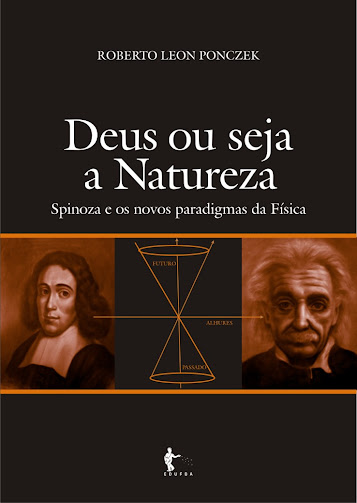
Imagens e textos unindo Spinoza a Einstein/ Images and texts linking Spinoza and Einstein

A aura de Spinoza paira sobre Einstein

Pequena casa em Rijnsburg

Livro de Registro da casa de Spinoza (Visita de Einstein em 1920)
A CRITICAL REVIEW OF THE TTP TO UNDERSTAND WHY WAS CONSIDERATED A BOOK "FORGED IN HELL".
A REVIEW OF BARUCH SPINOZA'S THEOLOGICAL-POLITICAL TREATISE TO UNDERSTAND WHY WAS CONSIDERED A BOOK “FORGED IN HELL”?
by
Roberto Leon Ponczek
Abstract
This article presents a critical review of Baruch Spinoza’s Theological-Political Treatise (Tractatus Theologico-Politicus), examining its revolutionary ideas and explaining why they were regarded as impious and subversive in his own time and for approximately one hundred and fifty years thereafter. Only from the nineteenth century onward did Spinoza come to be recognized as one of the principal precursors of the Enlightenment and modern secularism, particularly through the reinterpretations advanced by Hegel and, above all, Nietzsche. Nevertheless, some of his propositions remain controversial among conservative theologians and religious thinkers. The Theological-Political Treatise is here interpreted as one of the foundational texts of intellectual modernity, inaugurating a new relationship between religion, reason, and political authority.
Keywords: Baruch Spinoza; Theological-Political Treatise; Enlightenment; secularism; biblical criticism; freedom of thought.
1. General Aspects of the Work
In the Theological-Political Treatise, Spinoza develops an innovative critique of the traditional reading of the Bible, proposing that sacred texts should be studied historically by taking into account their authors, intended audiences, circumstances of composition, and linguistic particularities. This approach makes the Treatise one of the precursors of modern biblical criticism. More broadly, it anticipates the idea that religions should be understood not primarily as prophetic epiphanies but as historical narratives shaped by particular social and political conditions.
Spinoza argues that the prophets did not possess superior philosophical knowledge but rather an extraordinarily powerful imagination, which enabled them to convey moral teachings appropriate to the people of their time.
Consequently, religious truth should not be confused with scientific or philosophical truth. The purpose of Scripture is neither to teach cosmology nor metaphysics nor natural history, but rather to promote justice, charity, and ethical obedience.
One of the most revolutionary aspects of the work is its critique of the power exercised by theologians and religious authorities. Spinoza maintains that numerous wars, persecutions, and social conflicts have arisen from attempts to transform particular religious interpretations into universally binding truths. By denouncing superstition and fanaticism, he seeks to liberate religion from the dogmatic disputes that ultimately corrupt it.
At the political level, Spinoza argues that the State must exercise sovereign authority over public affairs, thereby preventing religious institutions from competing for political power. During the Middle Ages, for example, popes authority often rivaled and even surpassed the power of kings. Yet sovereign authority should not degenerate into tyranny. On the contrary, a rational State guarantees its citizens the freedom to think, to express their opinions, and to pursue truth. According to Spinoza, no one can entirely renounce the right to think independently, since this right belongs to human nature itself.
The Treatise anticipates several principles that would later become associated with the Enlightenment: religious tolerance, freedom of expression, the secular character of the State, and the primacy of critical reason. Its influence may be discerned in thinkers such as John Locke and, indirectly, in numerous eighteenth-century authors.
From a literary perspective, the text is distinguished by philosophical rigor, clarity, and argumentative force. It confronts established beliefs with arguments that continue to surprise contemporary readers because of their remarkable modernity. The Theological-Political Treatise remains relevant because it addresses questions that continue to shape modern societies: the boundaries between religion and politics, intellectual freedom, the role of rational criticism, and the dangers of fundamentalism.
In short, the Theological-Political Treatise is a foundational work of intellectual modernity. Its defense of freedom of thought and its critique of the absolutist pretensions of organized religion make it one of the most significant texts in the Western philosophical tradition. To read Spinoza today is to rediscover one of the most vigorous formulations of the idea that the pursuit of truth requires freedom and that no society can be genuinely free without guaranteeing its citizens the right to think and to dissent.
2. Context and Purpose of the Work
Spinoza wrote the Treatise in the Dutch Republic of the seventeenth century, one of the few places in Europe where a relative degree of freedom of expression existed. The book was published anonymously under a fictitious imprint because Spinoza knew that its arguments would prove explosive even within the relatively tolerant environment of the Netherlands, especially after the murder of the republican leaders De Witt brothers and the political ascendancy of the House of Orange and radical Calvinism.
The central thesis of the work may be summarized as follows: freedom of thought and philosophical inquiry are essential both to the peace of the State and to authentic religiosity.
3. Spinoza’s Revolutionary Concepts
a) Deus sive Natura
God is not a transcendent monarch seated above the clouds, judging, condemning, and intervening through miracles. Rather, God is Nature (Deus sive Natura): the single infinite substance possessing infinitely many attributes, of which human beings perceive only two - extension and thought. This conception therefore rejects the biblical notion of a personal God.
b) The Human Character of Scripture
The Bible was written by human beings at different historical moments and under specific political circumstances. Consequently, it contains errors, legends, and adaptations. Spinoza famously emphasizes the biblical passage in which Joshua commands the sun to stand still so that he may continue his battle against five enemy kings in daylight.
c) Critique of a complex dogmatic religion
Religious doctrines should be simple and reducible to a small number of principles, for an easy understanding by the simple people: God is omnipresent, observes all things, possesses authority over all beings, and grants salvation only to those who obey divine commands; God forgives the repentant and punishes transgressors. No official authorities are needed.
d) The Secularization of Political Authority
Neither priests nor theologians should govern the State. The sovereign may regulate public worship solely for the maintenance of public order, not because he enjoys any privileged access to God.
4. Why Was the Treatise Considered a “Damned” Book?
a) It Destroys the Monopoly of Official Interpretation
Both Christianity and Judaism have traditionally relied upon the idea that clergy and rabbinic authorities possess privileged authority to interpret the Word of God. Spinoza maintains that any person endowed with reason and sufficient knowledge of Hebrew may legitimately interpret Scripture. Such a position radically undermines institutional authority.
b) It Denies the Possibility of the Supernatural
For Spinoza, miracles do not exist. There are no miraculous crossings of seas, no divinely inflicted plagues upon Egypt, no miraculous healings, and no resurrection in the literal sense. Every event must admit of a rational explanation grounded in natural causes, even when such causes remain temporarily unknown.
c) It Rejects the Special Status of Prophets
Moses and Jesus possess no ontological status different from that of other wise figures, all were human. Moses is regarded just as an effective legislator who contributed decisively to the liberation and preservation of the Jewish people through desert. Jesus is admired for his persistent teaching of love of neighbor and for his unique capacity to communicate intellectually with God, “mind to mind.” Yet Spinoza denies Christ’s any miraculous powers.
For the monotheistic religions, this constituted one of the gravest conceivable heresies, for it effectively undermined their doctrinal foundations.
5. The Reduction of Religion to Ethics
If God desires only justice and charity, then doctrines such as the election of Israel as a uniquely chosen nation loses their theological privilege. All peoples and nations stand equally before God. This thesis also undoubtedly displeased the Beit Din, the tribunal of the Portuguese Jewish community of Amsterdam, which had already condemned Spinoza and pronounced the Cherem, (ban from the local community) against him even before the anonymous publication of the Treatise.
6. The Defense of the Secular State
Long before the expression “secular State” entered political vocabulary, Spinoza vigorously denied that the State should punish heresy or atheism. He rejected the widespread belief that heretics and atheists could not be good citizens and therefore represented a threat to social order.
Spinoza was excommunicated by the Talmud Torah, the Portuguese Synagogue of Amsterdam, in 1656, and the Theological-Political Treatise was condemned by the Catholic Church in 1679 and by Dutch Protestant authorities. Thus, both the philosopher and his work were rejected by virtually every religious establishment of their time and were almost unanimously regarded as heretical.
7. The Accusation of Atheism
Although Spinoza consistently declared himself a believer in God, his conception of an impersonal God, devoid of will and incapable of suspending the natural order, appeared to many of his contemporaries as little more than concealed atheism.
For nearly one hundred and fifty years, “Spinozism” functioned as a term of abuse. Even Enlightenment thinkers frequently avoided citing him publicly. Only in the nineteenth century did Hegel and Nietzsche contribute decisively to his rehabilitation and rediscovery.
8. Conclusion
The Theological-Political Treatise eventually became one of the manuals of critical modernity. It profoundly influenced the Enlightenment, modern biblical criticism, the separation between Church and State, and the emergence of secularism. It was therefore called a “book forged in hell” because it simultaneously challenged the possibility of miracles understood as suspensions of natural order, the authority of the clergy, and the union of religious faith with political power.
Spinoza did not seek to destroy religion. On the contrary, he regarded religion as useful for providing moral orientation to ordinary people, provided that it remained free from fanaticism. The difficulty, however, is that in the process of purifying religion, he rejected almost everything that religious institutions considered non-negotiable and introduced rational principles fundamentally at odds with their traditional doctrines.
I conclude with a question that accompanied me throughout my careful reading of the original text: Why does Spinoza criticize the Old Testament with such relentless severity, sparing almost none of its principal figures—with the notable exception of Solomon—while approaching the New Testament in a comparatively milder, and at times even remarkably sympathetic, manner, praising several of its protagonists like Paul and Jesus? I have my own hypotheses regarding this asymmetry; however, because they are exceedingly controversial, I leave the matter to a multidisciplinary studies made by historians and psychologists scholars.
References:
ISRAEL, Jonathan I. Radical Enlightenment. Oxford: Oxford University Press, 2001.
NADLER, Steven, Spinoza: A Life. Cambridge: Cambridge University Press, 1999.
_______________ Um livro forjado no inferno: o Tratado escandaloso de Espinosa e o nascimento da era secular. Tradução de Alexandre Morales. São Paulo: Três Estrelas, 2013.
PONCZEK, Roberto Leon. Deus ou seja a Natureza: Spinoza e os paradigmas da Física Moderna. 2. ed. Salvador: EDUFBA, 2013.
PREUS, J. Samuel. Spinoza and the Irrelevance of Biblical Authority. Cambridge: Cambridge University Press, 2001.
SPINOZA, Baruch. Tratado Teológico-Político. Tradução, introdução e notas de Diogo Pires Aurélio. São Paulo: Martins Fontes, 1ª Ed. 2003.
SPINOZA, Baruch. Tratado Teológico-Político. Tradução de J. Guinsburg e Newton Cunha. São Paulo: Perspectiva, 2014.
STRAUSS, Leo. Spinoza's Critique of Religion. Chicago: University of Chicago Press, 1965.


Assinar:
Postar comentários (Atom)
Nenhum comentário:
Postar um comentário